
From April 14 to 17, GEIA Asia 2026 – Asia-Pacific Embodied Intelligence and Humanoid Robotics Innovation Week was held in Shanghai. As a major industry event for embodied AI in the Asia-Pacific region, the conference brought together leading researchers, industry executives, and technology experts from around the world to explore emerging trends and commercialization pathways for humanoid robots and dexterous robotic hands.
Shihao Zhao, Founder and CEO of NeoteAI Tech Co., Ltd. (NeoteAI), was invited to deliver a keynote speech at the Dexterous Hand Innovation Forum. Under the theme "Enabling Machines to Perceive the World, Bringing Intelligence Within Reach," Zhao examined key technological challenges facing the embodied AI industry and shared NeoteAI's advances in tactile perception and its full-stack technology strategy.
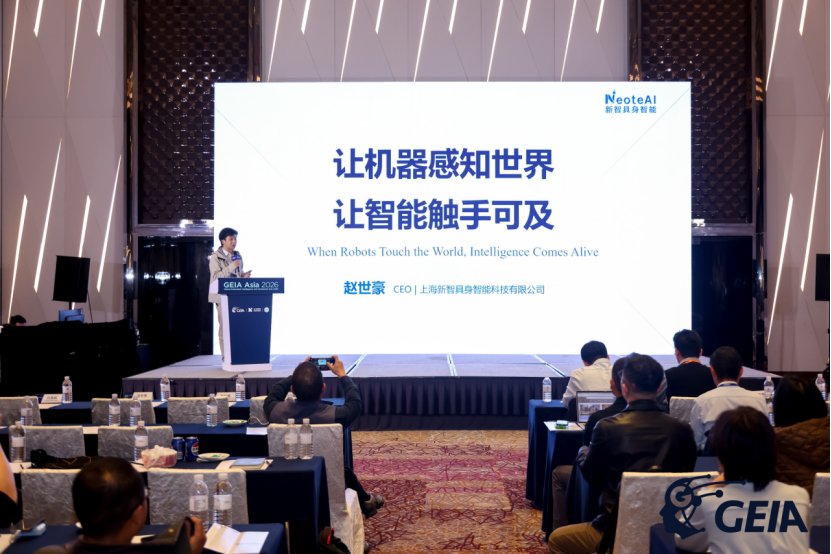
Vision Alone Is Not Enough for Real-World Physical Interaction
During his presentation, Zhao highlighted a common misconception in embodied AI development: the industry's long-standing reliance on a vision-centric approach.
While visual perception plays an essential role in robotic intelligence, relying exclusively on visual information presents fundamental limitations for robots that must physically interact with their environments.
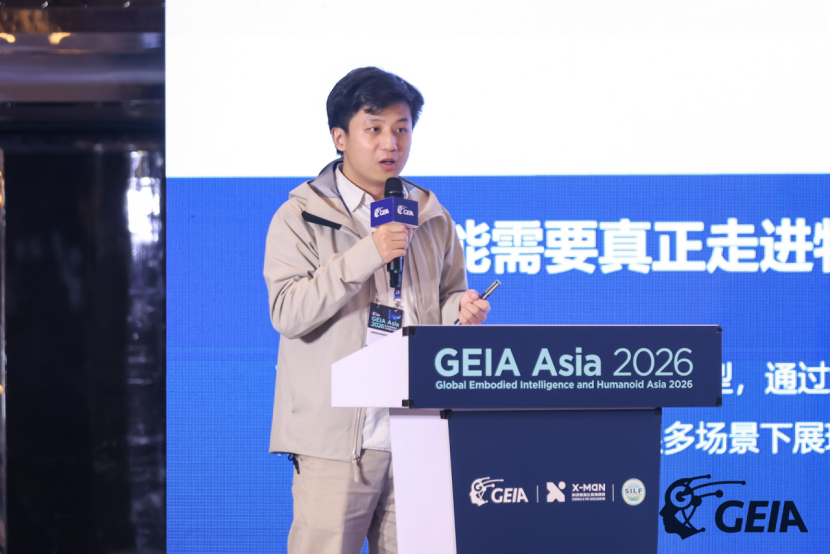
Zhao explained that whether robots are grasping fragile objects in everyday environments, manipulating deformable materials in industrial settings, or performing precision assembly and laboratory operations, visual information can primarily answer questions such as "Where is the object?" and "What is it?"
However, vision alone cannot adequately address critical questions such as "How much force should be applied?" and "How should the robot adjust its movements during contact?"
According to Zhao, these limitations are among the fundamental reasons why many existing dexterous robotic hands struggle with generalization, achieve limited task completion rates, and face difficulties operating reliably in complex real-world environments.
Touch Is an Essential Dimension of Embodied AI Perception
Through practical examples, Zhao illustrated the unique value of tactile information.
Visual observations can vary significantly depending on camera angles, lighting conditions, and environmental backgrounds. Tactile feedback, by contrast, provides direct physical information about contact and interaction, offering a more consistent basis for understanding forces and material responses.
He emphasized that tactile perception is just as important as vision and can be even more critical in many physical interaction scenarios.
For embodied AI to become truly useful in everyday life and industrial production, Zhao argued that the industry must move beyond the conventional "Visual-Centric" paradigm toward a new dual-centered "Vision + Touch" approach (Visual + Tactile-Centric).
NeoteAI's ultimate objective is not merely to develop sensors, collect data, or optimize models as isolated technological components.
Instead, the company aims to integrate these capabilities to establish a next-generation embodied AI paradigm designed specifically for interaction with the physical world.
This technological vision and its corresponding industrial development roadmap received strong recognition and enthusiastic applause from attending academicians, industry leaders, technical experts, and other participants.
Building a Full-Stack, Tactile-Driven Technology Ecosystem
Guided by this vision, NeoteAI has developed a comprehensive technology framework spanning foundational hardware, scalable data infrastructure, and advanced AI models.
Proprietary Visual-Tactile Sensors
NeoteAI's independently developed visual-tactile sensors leverage an optical tactile sensing approach to achieve pixel-level force perception, with hundreds of thousands of force-sensing information points.
Scalable Multimodal Data Collection
The company has established a large-scale, synchronized visual-tactile data collection center in China, featuring more than 50 dedicated workstations operating around the clock.
This infrastructure supports the continuous acquisition of high-quality multimodal interaction data for embodied AI model training.
Tactile-Integrated Embodied AI Models
NeoteAI deeply integrates tactile information into Vision-Language-Action (VLA) models, world models, and reinforcement learning frameworks, aiming to significantly improve robotic manipulation precision and generalization capabilities.
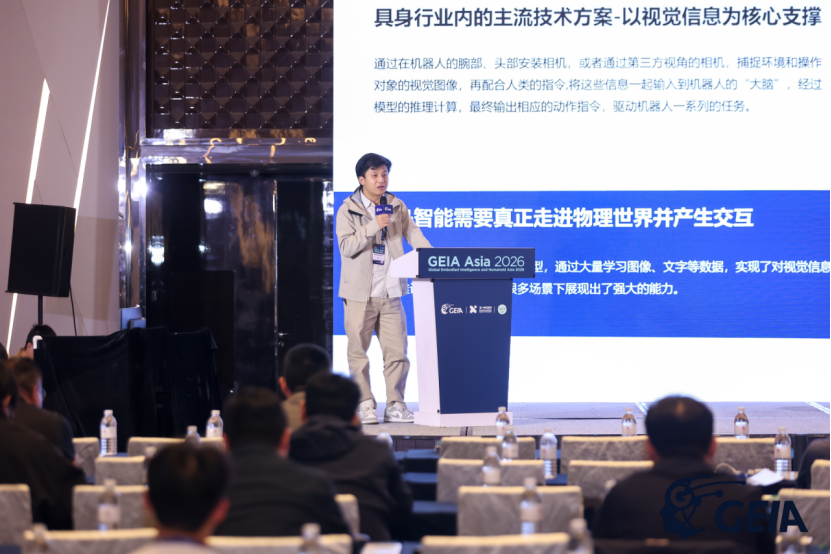
During the presentation, Zhao also made an important announcement: NeoteAI's proprietary series of tactile embodied AI models was scheduled for official release between June and July 2026.
The upcoming release was expected to demonstrate the transformative potential of tactile perception in enhancing robotic intelligence and physical manipulation capabilities.
Advancing Dexterous Robotic Hands and Accelerating Industrial Applications
As a company established to commercialize research originating from the Institute of Trustworthy Embodied Artificial Intelligence (TEAI) at Fudan University, NeoteAI remains committed to redefining robotic perception through tactile technologies.
Zhao's presentation at the Dexterous Hand Innovation Forum not only showcased the company's technological expertise and forward-looking strategy in tactile perception but also offered new perspectives on overcoming key barriers to the industrial adoption of dexterous robotic hands.
Looking ahead, NeoteAI will continue to advance its dual-centered "Vision + Touch" technology approach, accelerating the integration of tactile perception with dexterous robotic hands and humanoid robots.
By enabling robots to develop fine-grained tactile perception capabilities comparable to the sensitivity of human skin, the company aims to contribute essential technologies that support the large-scale deployment of embodied AI in real-world applications.
END