
On September 22, Li Qiang, a member of the Standing Committee of the Political Bureau of the Communist Party of China (CPC) Central Committee and Premier of the State Council, conducted an inspection tour in Shanghai. During the visit, he emphasized the importance of implementing President Xi Jinping's directives on developing advanced manufacturing and the guiding principles of the National Conference on Advanced Manufacturing. He called for advancing intelligent, green, and integrated development, deepening the integration of technological and industrial innovation, vigorously developing next-generation intelligent manufacturing, accelerating the growth of emerging and future industries, and continuously strengthening the advanced manufacturing sector.
At Shanghai Electric's National AI Application Pilot Base, Premier Li inspected special-purpose robots, industrial robots, and demonstrations of their applications in complex scenarios. He also received briefings on the development of integrated “AI+” service providers and AI-native factories, and visited a pilot workshop for intelligent robot assembly and commissioning.
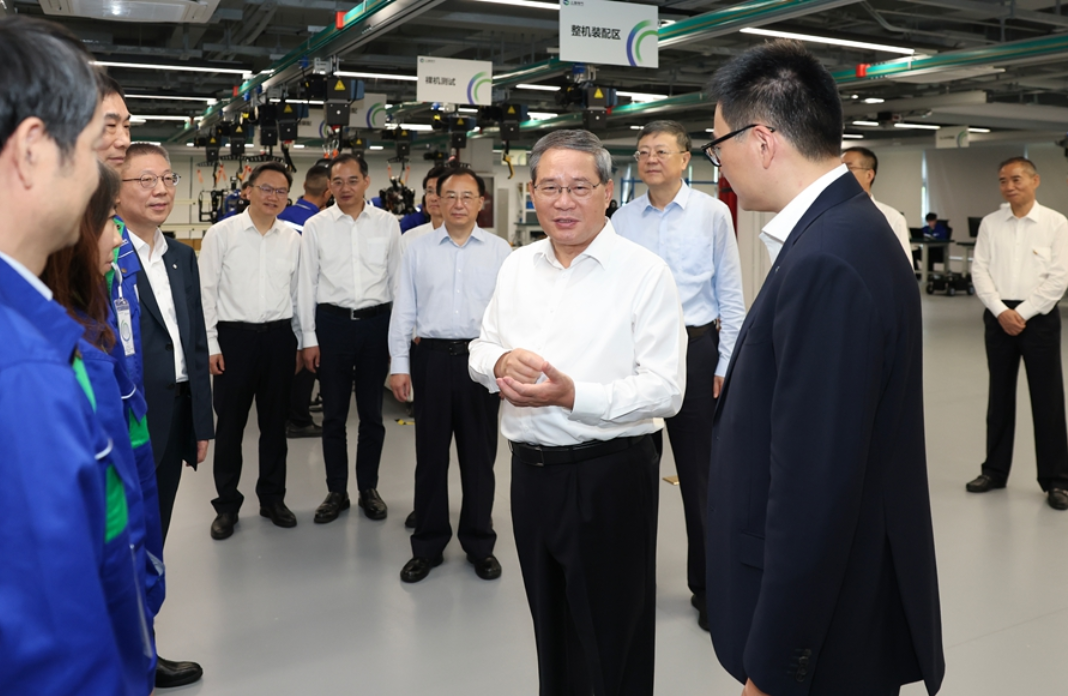
Image Source: Xinhua News Agency. Premier Li Qiang visits the intelligent robot assembly and commissioning pilot workshop at Shanghai Electric's National AI Application Pilot Base.
During the inspection, Premier Li stressed the need to leverage the complementary strengths of manufacturing and digital intelligence technologies to further advance the “AI + Manufacturing” initiative. He highlighted the importance of focusing on key areas such as industrial design, pilot-scale validation, and intelligent operations and maintenance, while strengthening the provision of integrated services and diversified solutions to empower the high-quality development of advanced manufacturing.
The demonstrations of intelligent robots operating in complex industrial environments showcased practical achievements in integrating AI with advanced manufacturing. Among the projects presented at Shanghai Electric's National AI Application Pilot Base was an automated data interface cable connection project for rail transit systems, jointly developed by NeoteAI Tech Co., Ltd. (NeoteAI), the Institute of Trustworthy Embodied Artificial Intelligence at Fudan University, and Shanghai Electric.
Focusing on the demands for dexterous manipulation in rail transit equipment maintenance and industrial automation, the project addresses technical challenges involving flexible cable manipulation, precision alignment, and complex interface connections, demonstrating the practical capabilities of tactile embodied AI in complex industrial environments.
As Shanghai Electric's technology partner in embodied AI, NeoteAI has been advancing application validation in areas such as rail transit equipment maintenance, with its tactile embodied foundation models at the core of its technology. By integrating real-world physical interaction data with intelligent manipulation technologies, NeoteAI aims to enhance robots' fine-grained perception, autonomous decision-making, and stable manipulation capabilities in complex industrial environments, supporting the intelligent transformation of advanced manufacturing.
Deepening Industrial Collaboration to Advance Tactile Embodied AI Applications in Complex Industrial Environments
The project was previously showcased at Shanghai Electric's collaborative exhibition booth during the 2026 World Artificial Intelligence Conference (WAIC), demonstrating the dexterous manipulation capabilities of tactile embodied AI in rail transit equipment maintenance scenarios.
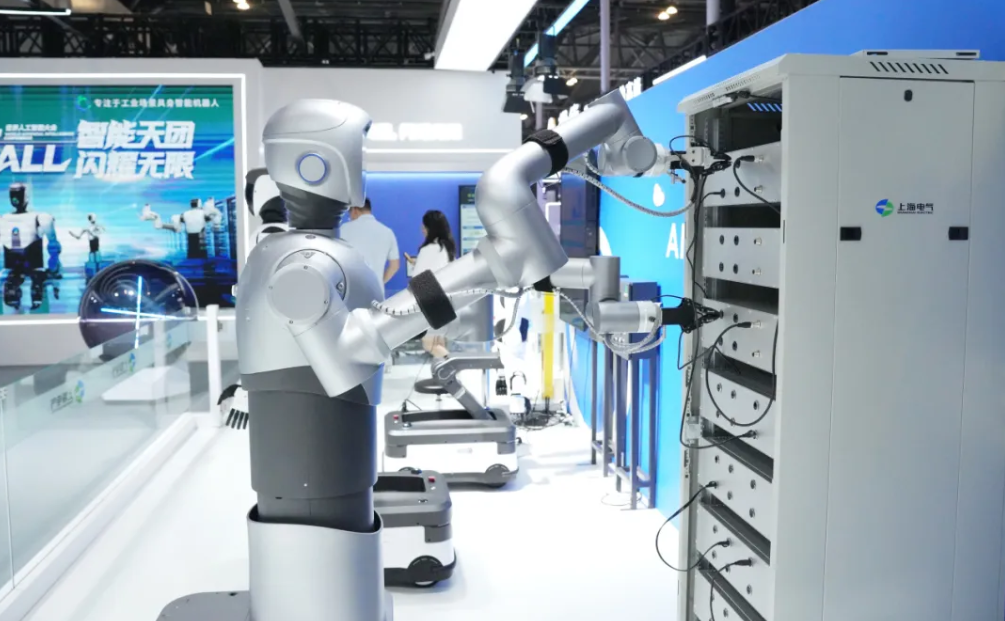
Shanghai Electric's exhibition booth at WAIC 2026, featuring a demonstration of rail transit equipment maintenance and industrial automation. The robotic system was equipped with NeoteAI's proprietary vision-based tactile sensors.
The automated data interface cable connection task for rail transit systems involves multiple stages, including interface recognition, cable grasping, pose adjustment, precision alignment, and stable connector insertion. Due to the flexibility of cables and the limited workspace around connection interfaces, the manipulation process is highly sensitive to positional deviations, contact resistance, and material deformation. These challenges place significant demands on robots' fine-grained perception, dynamic decision-making, and manipulation stability.
To address these technical challenges, NeoteAI developed an intelligent manipulation system integrating perception, decision-making, and execution, powered by its proprietary tactile embodied foundation models, high-precision vision-based tactile sensors, and real-world physical interaction data.
The robot uses visual perception to identify interface locations and cable poses, while tactile feedback enables real-time sensing of contact conditions, applied forces, and slippage. Based on this physical interaction information, the embodied AI model dynamically adjusts the robotic arm's pose, insertion direction, and applied force to meet the demands of dexterous manipulation under complex operating conditions, improving the stability of interface connections and continuous task execution.
This application further validates the industrial value of NeoteAI's full-stack “Sensor–Data–Model” technology framework, providing valuable practical experience for the engineering validation and industrial deployment of tactile embodied AI.
Advancing the “AI + Manufacturing” Initiative to Accelerate the Industrial Deployment of Embodied AI
During his inspection tour in Shanghai, Premier Li Qiang emphasized the importance of harnessing AI to better empower advanced manufacturing, promoting intelligent transformation across the entire process of research and development, production, and management, and strengthening technological innovation and real-world applications to address common challenges in manufacturing.
Aligned with this development direction, NeoteAI will continue to deepen industrial collaboration with leading manufacturers such as Shanghai Electric. Guided by the practical needs of real-world industrial environments, the company will accelerate the development and engineering deployment of core tactile embodied foundation model technologies, further integrating embodied AI with advanced manufacturing.
Looking ahead, NeoteAI will focus on application scenarios including precision assembly, flexible cable manipulation, industrial equipment operations and maintenance, and complex physical interactions. The company will continue to advance the integration and adaptation of its model capabilities with robotic hardware, end effectors, and industrial control systems, further improving manipulation stability, task generalization, and engineering delivery capabilities in real-world production environments.
NeoteAI will continue to advance the development priorities highlighted during the inspection, with tactile embodied foundation models at the core of its technology and real-world industrial needs guiding its innovation. By fostering deeper integration between technological and industrial innovation, NeoteAI aims to bring embodied AI technologies from fundamental research into industrial operations, providing robust technological support for the intelligent transformation of advanced manufacturing and the development of next-generation intelligent manufacturing.